

You called in the professionals. Your flat was treated top to bottom. For a week — maybe two — things were quiet. Then the cockroaches came back. The ants reappeared. And you're left wondering what went wrong.
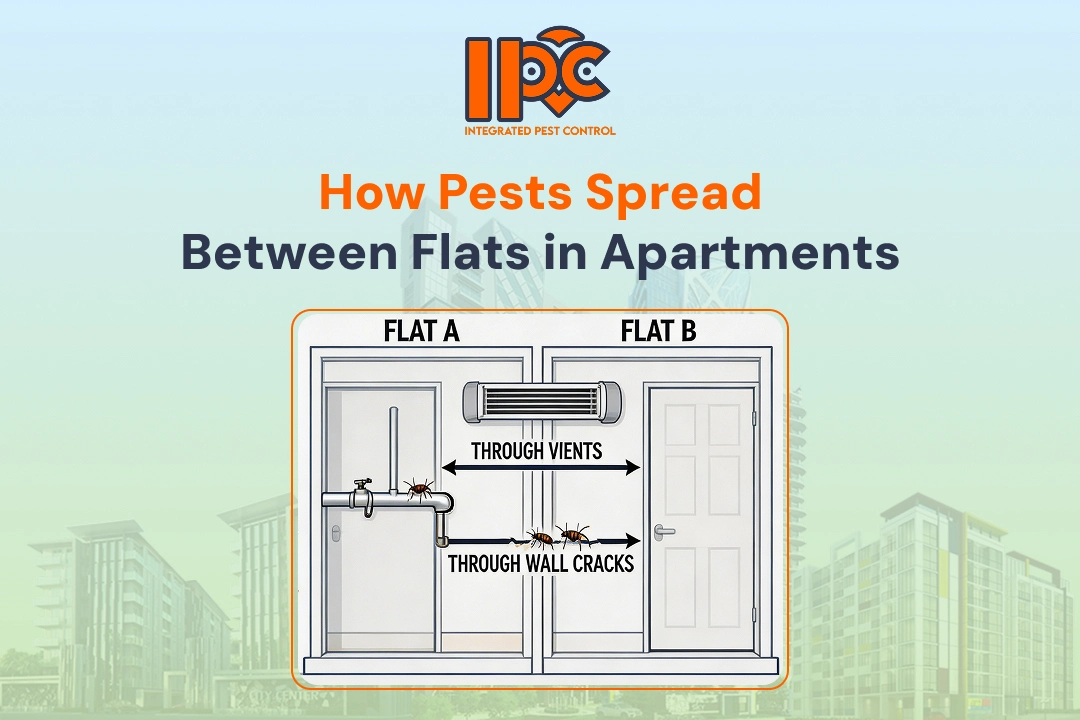
In most cases, nothing went wrong with your treatment. The problem is that your flat shares a building with dozens — sometimes hundreds — of other units, and pests don't recognise the concept of private property. Walls, pipes, ducts, and structural gaps that seem perfectly solid to you are, to a cockroach or rodent, a connected highway running through the entire building.
This is the reality of pests spreading between apartments in India — and it's a problem that's almost completely absent from mainstream pest control advice. A single-flat treatment, no matter how thorough, cannot stop re-infestation if the source is a neighbouring unit. Understanding why this happens is the first step toward a solution that actually lasts. For apartment communities looking for a comprehensive approach, IPC Bharat's housing society pest control services are built specifically around this challenge.
How Pests Move Between Flats in Apartment Buildings
Modern apartment construction creates an interconnected internal environment that most residents never think about. Behind the walls, beneath the floors, and above the ceilings runs an elaborate network of shared infrastructure — and it functions as a pest transit system that links every unit in the building.
Through Shared Walls, Drainage Pipes, and Electrical Conduits
Drainage pipes are among the most significant migration routes for cockroaches. The German cockroach — the most common indoor pest in Indian apartments — thrives in the humid, warm environment inside drain pipes and can travel vertically through a building's plumbing stack with ease, emerging in any flat where there's an accessible gap around a pipe fitting.
Electrical conduits present a similar problem. The wiring that runs from your distribution board through the walls connects to adjacent units through shared junction boxes. Cockroaches and even small rodents navigate these hollow channels regularly. A pest nest in a neighbouring flat's kitchen wall can dispatch scouts into yours through a gap no larger than a five-rupee coin.
Shared walls — particularly those with cracks in the plaster, poorly sealed fixture holes, or old wiring penetrations — provide direct routes between units on the same floor. Even a hairline crack at floor level is sufficient for a cockroach to pass through repeatedly.
💡 Key fact: German cockroaches can squeeze through gaps as narrow as 1.5mm. A gap you can barely see is more than enough for an entire colony to exploit.
Via Common Areas: Garbage Rooms, Staircases, Lift Shafts
Common areas are pest staging grounds. The garbage collection room at basement or ground level is, for most apartment buildings in India, an untreated reservoir of cockroaches, rodents, and flies. Pests breed there and then fan outward — up staircases, through lift shafts, and into any unit where a door or window is left open at the wrong moment.
Lift shafts deserve special mention. The shaft runs the full height of the building, is rarely if ever treated for pests, creates upward airflow through the stack effect, and provides rodents with climbing opportunities via the guide rails and cables. Rats found in upper-floor flats frequently arrive via the lift shaft rather than the main staircase.
Staircases act as open corridors. Cockroaches detected on the staircase landing at 2am are not passing through — they're foraging from nests in the common area or in a nearby flat, and they'll return to whichever unit offers the most accessible food and shelter.
Through Structural Gaps and Cracks in Ceilings and Floors
Settlement cracks in older apartment buildings — particularly at ceiling-wall junctions and around floor-mounted plumbing — create direct vertical connections between floors. A colony on the 4th floor can establish a satellite presence on the 5th and 3rd simultaneously through these structural pathways.
Expansion joints, false ceiling cavities, and gaps around bathroom exhaust fans are equally important. The false ceiling space above a kitchen or bathroom is frequently connected across multiple units and functions as a shared pest corridor — invisible, warm, humid, and completely untreated.
Which Pests Are Most Likely to Migrate Between Flats?
Not all pests migrate with equal ease. Understanding which species are most prone to inter-flat movement helps prioritise where treatment and prevention efforts should focus.
Cockroaches: The Most Frequent Migrant
The question "cockroaches coming from neighbour flat India" is one of the most searched pest queries in the country — and with good reason. German cockroaches reproduce rapidly (a single female can produce over 30,000 offspring in a year under ideal conditions), thrive in the warm and humid environment inside apartment plumbing, and are remarkably effective at locating new food sources across building infrastructure. A heavily infested unit next door effectively functions as a continuous resupply depot for yours.
Rodents: The Vertical Travellers
Rats are excellent climbers and can ascend rough walls, drain pipes, and cabling with ease. In apartment buildings, the roof-rat species (Rattus rattus) is particularly adept at using lift shafts and ceiling cavities for vertical movement. A rodent nest in the basement or garbage room isn't just a ground-floor problem — it's a building-wide problem.
Bed Bugs: The Silent Spreaders
Bed bugs travel differently from most pests — they hitchhike on people, luggage, and second-hand furniture rather than migrating through infrastructure. But once established in one flat, they can spread to adjacent units through electrical outlets, behind skirting boards, and through shared wall penetrations. In dense apartment buildings, a single infestation that's inadequately treated tends to become a building-wide problem within months.
Why Treating Only Your Flat Doesn't Work
The Re-Infestation Cycle
Here's the cycle that plays out in apartment buildings across India, repeatedly:
Resident A notices cockroaches and books a single-flat treatment
Pest control eliminates the active infestation in Flat A
Resident A's flat is clean — for two to four weeks
Cockroaches from the untreated nest in Flat B (or the common area) detect the absence of competition and begin colonising Flat A's accessible resources
Flat A is re-infested, often worse than before, because the colony in Flat B has had time to grow
Resident A books another single-flat treatment. The cycle repeats.
This is not a failure of the pest control product or the technician's competence. It is a structural failure — the source of re-infestation has never been addressed. As long as an untreated reservoir of pests exists within the building's connected infrastructure, single-flat treatments will provide only temporary relief.
💡 Industry insight: Pest control companies that only offer single-flat treatments are not equipped to solve building-level infestation. The appropriate solution is a coordinated, multi-unit approach.
The economic cost of this cycle is significant. Residents who re-book single-flat treatments every two months spend far more over a year than a building-level annual maintenance contract (AMC) would cost — and get worse results. This is one of the clearest cases in home maintenance where collective action by the housing society is cheaper and more effective than individual action by each resident.
What Apartment Residents Can Do Individually
Seal Entry Points and Reduce Access
While a building-level solution is ultimately what's needed, individual residents can take meaningful steps to reduce their flat's vulnerability to pests entering from walls and pipes.
Seal pipe penetrations: Use silicone sealant or hydraulic cement to fill gaps around water supply pipes, drain pipes, and electrical conduits where they enter the flat through walls or floors. Pay particular attention to the gaps around S-traps under kitchen and bathroom sinks.
Install drain covers: Floor drains and floor traps that are left open are direct entry points for cockroaches moving through the building's drainage system. Use mesh drain covers that allow water flow but block pest entry.
Fill wall cracks: Use epoxy filler or cement to close cracks at skirting level, ceiling-wall junctions, and around window and door frames. Even small cracks at floor level are significant migration routes.
Check electrical boxes: Switch and socket boxes on shared walls often have gaps between the box and the plaster. These can be sealed with mesh and silicone without affecting the electrical function.
Use door sweeps: A gap under your flat's entrance door — especially if you're near a garbage room or common staircase — is an easy entry point for cockroaches foraging at night.
Talk to Your Neighbours and RWA
This is the step most residents avoid, but it's often the most impactful. If you suspect cockroaches are coming from a neighbour's flat, raising the issue through your RWA or housing society committee — tactfully and through proper channels — can prompt coordinated action. Many RWAs in India are now responsive to pest control concerns once the building-level dimension of the problem is explained clearly.
If your society doesn't have a pest control policy, this is an appropriate topic to raise at the next AGM or residents' committee meeting. Presenting the re-infestation cycle (as explained above) typically makes the case clearly — residents who have been spending repeatedly on single-flat treatments tend to be immediately receptive.\
Why Housing Societies Need a Building-Level Pest Control Plan
Coordinated Treatment for All Flats and Common Areas
A building-level pest management plan works on the principle that all potential nesting sites, migration routes, and food sources within the structure are addressed simultaneously — or in a coordinated sequence — rather than piecemeal. This eliminates the untreated reservoirs that drive re-infestation.
For housing society pest control in India, an effective building-level plan typically includes:
Treatment of all common areas: garbage rooms, lift shafts and pits, pump rooms, basement parking, terrace, and staircases
Coordinated treatment of all residential flats — ideally in a single day or over a tightly scheduled two-day window
Targeted treatment of known pest hotspots: drainage inspection chambers, external drain channels, false ceiling cavities
Sealing recommendations for building management: identification of structural gaps that should be addressed by the society's maintenance team
A scheduled follow-up visit to assess treatment efficacy and address any re-emergence before it becomes a re-infestation
The timing of coordinated treatment matters. If ten flats are treated on Day 1 and five neighbouring flats aren't treated until Day 14, the untreated flats serve as a refuge for pests displaced from the treated units — reducing the overall efficacy of the programme.
Annual Maintenance Contracts (AMC) for Apartment Buildings
A pest control AMC for an apartment building provides scheduled, year-round protection across the entire structure. For facility managers, RWA committees, and building owners, a building-level AMC offers predictable cost, professional documentation (important for BBMP, BDA, or municipal compliance in some cities), and continuous protection rather than reactive treatment after infestations become visible. IPC Bharat's pest control AMC for housing societies covers both residential units and all common areas under a single coordinated contract.
IPC Bharat's Society-Level Pest Control and AMC Solutions
IPC Bharat has developed specific protocols for apartment building and housing society pest management — distinct from single-flat residential treatment — because the problem demands a different approach.
Our building-level service begins with a pest audit: a systematic inspection of the entire building including all common areas, roof, basement, drainage infrastructure, and a sample of residential units. The audit produces a written assessment identifying active infestation zones, migration routes, structural vulnerabilities, and a recommended treatment sequence.
Treatment uses integrated pest management (IPM) principles — combining chemical treatment (gel baits for cockroaches, rodenticide stations for rats, residual sprays for common areas) with non-chemical interventions (physical exclusion recommendations, hygiene guidance, and structural sealing advice). The combination is significantly more durable than spray-only approaches.
For residential complexes, we offer both one-time building-level clearance treatments and ongoing AMC programmes with quarterly or monthly scheduled visits. Our pest control services for apartments in Kolkata and Guwahati include written service reports after each visit, which satisfy documentation requirements for building compliance and society records.
RWA committees and facility managers can request a no-obligation building pest audit to understand the scope of the infestation and receive a detailed proposal. A well-managed building is more attractive to residents and commands better maintenance ratings — pest control is a meaningful part of that picture.
Frequently Asked Questions
Why do pests keep coming back after pest control treatment in my flat?
If pests return after a thorough single-flat treatment, the most likely explanation is that the source of re-infestation lies in a neighbouring unit, common area, or shared building infrastructure such as drainage pipes, electrical conduits, or ceiling cavities. Treating one flat cannot eliminate pests whose nest is located in an adjacent or connected space.
How do cockroaches travel between flats in apartment buildings?
Cockroaches travel between flats primarily through the building's drainage system (moving through drain pipes and emerging where fittings are poorly sealed), through electrical conduits and junction boxes in shared walls, through cracks in plasterwork at floor and ceiling level, and via common areas such as garbage rooms and staircases.
Can pests really come from a neighbour's flat?
Yes — and this is more common than most residents realise. A heavily infested neighbouring unit continuously replenishes pest populations in adjacent flats through shared building infrastructure. German cockroaches, in particular, are well adapted to exploiting the connected pipe and conduit networks in apartment buildings for inter-flat migration.
What should I do if I suspect cockroaches are coming from my neighbour's flat?
Start by sealing visible entry points in your own flat — gaps around pipes under sinks, floor drain openings, cracks at skirting level, and gaps in electrical boxes. Then raise the issue through your housing society committee or RWA, recommending a coordinated building-level treatment. A pest audit of the full building will identify the actual source and inform an effective treatment plan.
What is included in a housing society pest control plan?
A comprehensive housing society pest control plan covers all common areas (garbage room, basement, lift shaft and pit, staircases, pump room, terrace), all or most residential flats in a coordinated schedule, targeted treatment of drainage infrastructure, and follow-up visits. A quality provider will also produce a written pest audit and service report after each treatment.
Is a building-level pest control AMC more cost-effective than individual flat treatments?
For most apartment buildings with recurring pest problems, yes. Residents who repeatedly book single-flat treatments typically spend more over a 12-month period — with worse outcomes — than a building-level AMC covering all units and common areas would cost when split across the society. The AMC also eliminates the primary driver of re-infestation: untreated neighbouring units.
Does IPC Bharat offer pest control services for housing societies in Kolkata and Guwahati?
Yes. IPC Bharat provides specialist society-level pest management services including building pest audits, coordinated multi-flat treatment programmes, common area pest control, and annual maintenance contracts (AMC) for apartment complexes in Kolkata and Guwahati.
Conclusion: Pests Don't Respect Flat Boundaries — Your Pest Control Shouldn't Either
Pests spreading between apartments in India is not a fringe problem. It's the everyday reality of apartment living — and it explains why single-flat treatments leave so many residents frustrated, cycling through repeated bookings without lasting results.
The solution is not a better product or a more aggressive spray. It's treating the problem at the level it actually exists: the building. When all units and common areas are addressed in a coordinated programme, the untreated reservoirs that drive re-infestation are eliminated — and the results last.
For individual residents, that means sealing your flat's entry points and advocating for building-level action through your RWA. For housing societies and facility managers, it means moving from reactive single-flat bookings to a structured, proactive building-wide pest management programme.
IPC Bharat specialises in exactly this kind of society-level solution. Book a building pest audit with our team to understand where the infestation is actually originating, what migration routes are active in your building's infrastructure, and what a coordinated treatment programme would involve. Visit our apartment and housing society pest control services page to get started — or contact us directly to discuss an AMC proposal for your residential complex.